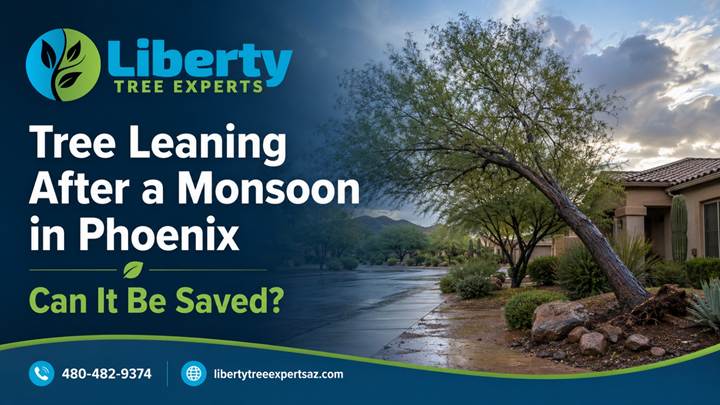
A tree that suddenly leans after an Arizona monsoon needs attention, even if it is still standing. Strong wind places heavy pressure on the canopy, while rain can soften the soil around the root system. Together, those conditions may allow part of the root plate to lift or shift.
A long established lean is not always an emergency. A new lean is different because it may indicate recent root movement. The safest next step depends on the tree’s size, location and the amount of damage below and above ground.
Keep People Away From the Fall Zone
Do not park, sit or work beneath a newly leaning tree. Keep children and pets out of the area, particularly when the tree is close to a home, wall, driveway or neighboring property.
If branches or the trunk are touching a power line, stay well away and contact the utility company. Do not climb the tree, use a pole saw or attempt to pull it away from the line. A damaged tree can move unexpectedly, even after the storm appears to have passed.
Look for Movement Around the Roots
Stand at a safe distance and examine the base. Fresh cracks in the soil, raised ground on one side or exposed roots can indicate that the root plate has shifted. A gap opening between the trunk and soil is another reason to arrange a prompt inspection.
Compare the tree with older photographs when available. This can help establish whether the lean existed before the storm or has recently become more pronounced.
Do not pile soil over lifted roots or run irrigation immediately to settle the ground. Extra water may further soften already saturated soil.
Check the Trunk and Main Branches
A leaning tree may also have damage higher in the canopy. Look for a split trunk, a major limb pulling away from its attachment or hanging branches caught above the ground.
Cracks between two trunks are especially concerning because wind can widen an existing weakness. Listen for unusual creaking or popping, but do not move closer to investigate.
Smaller broken branches can often be removed through corrective pruning. A severely split trunk or extensive damage to the main structure may leave removal as the safer option.
Can a Leaning Tree Be Straightened?
A small, recently planted tree may sometimes be repositioned and supported when most of the roots remain intact. The work should be done promptly and the staking system must allow some normal trunk movement.
A mature tree is a different problem. Pulling it upright with a vehicle, cable or improvised anchor can damage additional roots and place anyone nearby at risk. Staking does not restore a large root system that has failed.
An arborist may recommend monitoring, selective pruning, support work or removal. The decision depends on the root condition, trunk strength, species and what would be struck if the tree fell.
Do Not Remove Healthy Limbs at Random
Homeowners sometimes try to lighten a leaning tree by cutting off large branches. Poorly placed cuts can make the canopy more unbalanced, create large wounds and expose previously shaded bark to intense Arizona sun.
Topping is not a safe solution. It removes major portions of the crown and encourages weak new growth. Any weight reduction should be planned around the tree’s structure rather than simply removing the easiest limbs to reach.
Document Storm Damage Before Cleanup
Take photographs of the tree, lifted soil and any damage to buildings, fences or vehicles. Contact the insurance company when property has been affected and ask what documentation it requires before cleanup begins.
Leave dangerous cutting and rigging to trained professionals. Fallen trunks and partially broken limbs may remain under tension and can shift when cut.
Schedule a Tree Safety Assessment With Liberty Tree Experts
Liberty Tree Experts provides tree health assessments, storm damage cleanup, pruning and tree removal throughout Scottsdale, Mesa, Tempe and the Phoenix Valley. Its certified arborists can assess a newly leaning tree and explain whether corrective care or removal is the safer choice. Call
480-482-9374 for a free estimate before the next storm places additional pressure on a damaged root system.
References
Liberty Tree Experts: Storm Damage Cleanup
Liberty Tree Experts: Tree Health Assessments
International Society of Arboriculture: Storm Related Tree Damage
University of Minnesota Extension: Storm Damage to Landscape Trees
Arbor Day Foundation: Storm Recovery for Homeowners